Have you ever wondered what actually makes up the religion of Islam? Is it just about praying and fasting, or is there more to it?
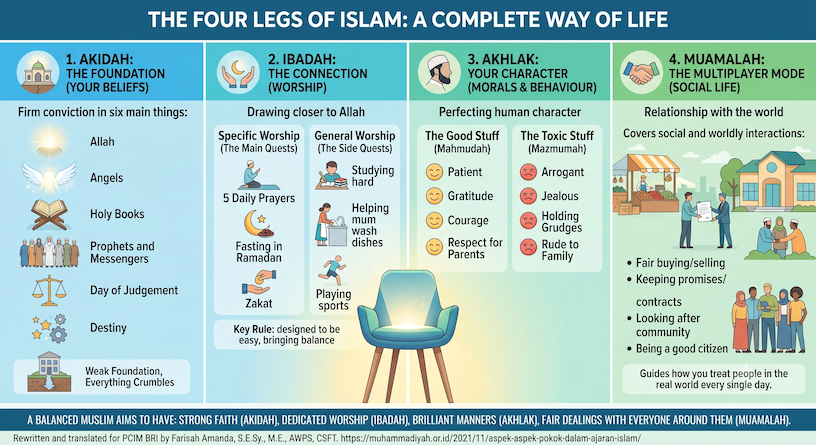
If you want to understand how Islam works, imagine it as a super-sturdy chair with four legs. If one leg is missing, the chair wobbles. According to Islamic scholars, the "four legs" that hold up a Muslim's entire way of life are Akidah, Ibadah, Akhlak, and Muamalah.
Let’s break down what these actually mean in plain English.
1. Akidah: The Foundation (Your Beliefs)
Before you do anything in Islam, you have to believe in it. Akidah is your belief system. It’s what you hold true deep down in your heart. You can think of it as the foundation of a house—if the foundation is weak, everything else crumbles.
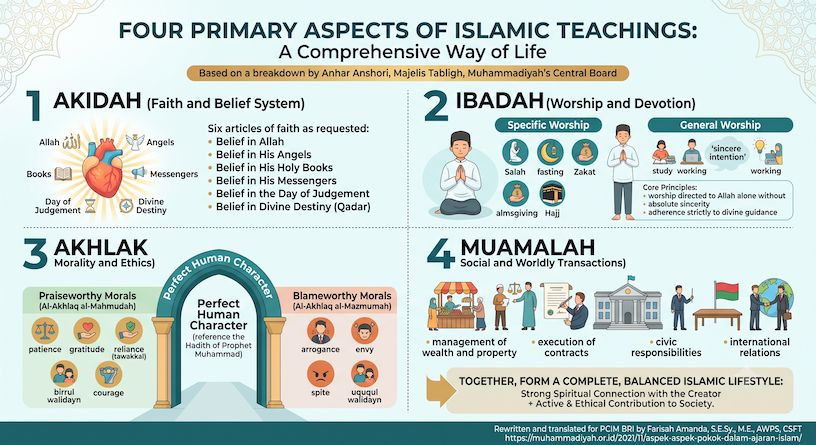
In Islam, this means firmly believing in six main things:
Allah (God)
The Angels
The Holy Books (like the Qur'an)
The Prophets and Messengers
The Day of Judgement
Destiny (that Allah has a master plan)
2. Ibadah: The Connection (Worship)
Ibadah is how you connect with Allah. It's about showing your devotion by doing what He asks and avoiding what He forbids. Interestingly, worship in Islam is split into two categories:
Specific Worship (The Main Quests): These are the strict rituals with set rules, like the five daily prayers (Salah), fasting in Ramadan, or giving to charity (Zakat). You can’t just make up your own way to do these; you have to follow exactly how the Prophet Muhammad (ﷺ) did them.
General Worship (The Side Quests): This is the cool part. Any normal, everyday thing you do can count as worship if you do it with a good intention to please Allah. Studying hard for your GCSEs, helping your mum wash the dishes, or even playing sports to stay healthy can all count as Ibadah!
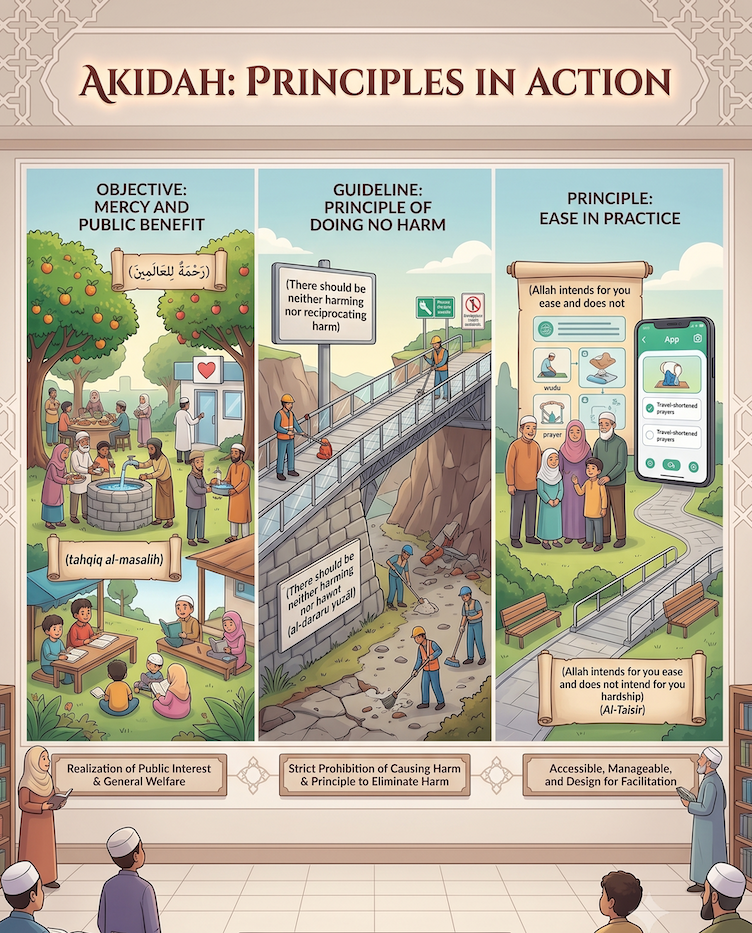
Key Rule: Worship in Islam isn't meant to be insanely difficult. It is designed to be easy, bringing balance to your physical and spiritual life.
3. Akhlak: Your Character (Morals and Behaviour)
It’s not enough to just pray; you also have to be a genuinely good person. Akhlak is all about your personality, your manners, and how you behave. In fact, Prophet Muhammad (ﷺ) once said he was sent to perfect human character.
The Good Stuff (Mahmudah): This includes being patient, showing gratitude, having courage, and treating your parents with massive respect.
The Toxic Stuff (Mazmumah): These are the traits you need to ditch. Things like being arrogant, getting jealous of your mates, holding grudges, or being rude to your family.
4. Muamalah: The Multiplayer Mode (Social Life)
If Ibadah is about your relationship with God, Muamalah is about your relationship with the rest of the world. It’s the rulebook for society.
This aspect covers all your social and worldly interactions. It teaches Muslims how to be fair and honest when buying or selling things, how to keep promises and contracts, how to look after the community, and how to be a good citizen. It proves that Islam isn't just something you do alone in your bedroom or in the mosque—it guides how you treat people in the real world every single day.
To sum it up: A balanced Muslim aims to have strong faith (Akidah), dedicated worship (Ibadah), brilliant manners (Akhlak), and fair dealings with everyone around them (Muamalah).
Rewritten and translated for PCIM BRI by Farisah Amanda, S.E.Sy., M.E., AWPS, CSFT
https://muhammadiyah.or.id/2021/11/aspek-aspek-pokok-dalam-ajaran-islam/




No comments yet. Be the first to share your thoughts!