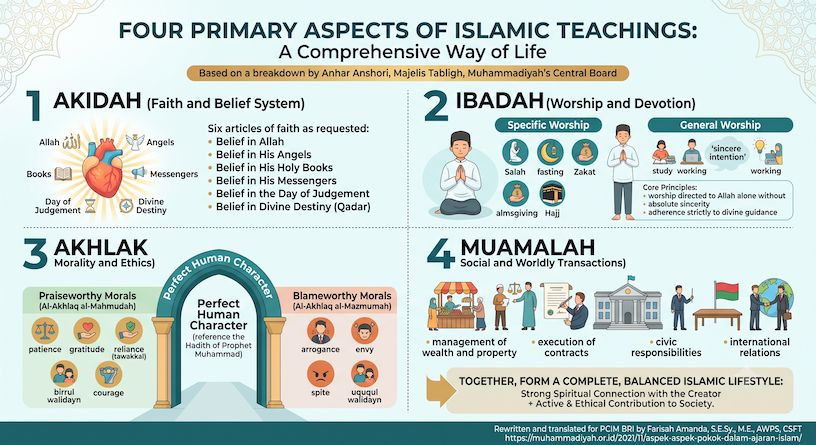
Islam is a comprehensive way of life built upon specific foundational elements. According to Anhar Anshori, a member of the Majelis Tabligh of Muhammadiyah's Central Board, Islamic teachings are anchored in four primary aspects: Akidah, Ibadah, Akhlak, and Muamalah.
Speaking at a Tarjih School programme held at the Universitas Ahmad Dahlan (UAD) Islamic Centre, Anshori provided a clear breakdown of how these four elements work together to form a complete Islamic lifestyle.
1. Akidah (Faith and Belief System)
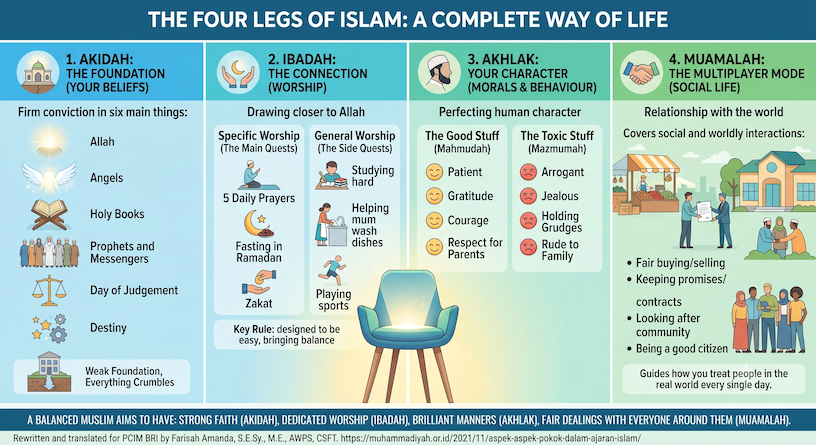
Akidah is the theological core of Islam. It represents the belief system that every Muslim must hold in their heart. This aspect encompasses a firm conviction in the six articles of faith:
Belief in Allah
Belief in His Angels
Belief in His Holy Books
Belief in His Messengers
Belief in the Day of Judgement
Belief in Divine Destiny (Qadar)
2. Ibadah (Worship and Devotion)
Ibadah is the active process of drawing closer to Allah (taqarrub). It involves obeying His commands, avoiding His prohibitions, and practising what He permits. Anshori explains that Ibadah operates across two distinct dimensions:
Specific Worship: These are the ritualistic acts of devotion strictly regulated by the Qur'an and the Prophet's Sunnah. The methods, timings, and conditions are explicitly prescribed, as seen in the five daily prayers (Salah), fasting, almsgiving (Zakat), and pilgrimage (Hajj).
General Worship: This encompasses any permissible daily activity or worldly action that is performed with a sincere intention to seek Allah's pleasure.
The core principles of Ibadah dictate that worship must be directed to Allah alone without intermediaries, performed with absolute sincerity, and adhere strictly to divine guidance. Furthermore, worship in Islam is designed to balance physical and spiritual needs, bringing ease to the believer rather than hardship.
3. Akhlak (Morality and Ethics)
Akhlak refers to the deeply ingrained character traits within a person's soul that manifest as everyday behaviour. As Islamic tradition highlights, Prophet Muhammad (ﷺ) was sent primarily to perfect human character. This aspect is divided into two categories:
Praiseworthy Morals (Al-Akhlaq al-Mahmudah): Virtues such as patience, gratitude, reliance on Allah (tawakkal), honouring one's parents (birrul walidayn), and courage (syaja’ah).
Blameworthy Morals (Al-Akhlaq al-Mazmumah): Destructive traits that a Muslim must avoid, including arrogance, envy, spite, and disrespecting one's parents (uququl walidayn).
4. Muamalah (Social and Worldly Transactions)
While the previous aspects focus heavily on personal faith and individual character, Muamalah governs the societal and interpersonal dimensions of human life on Earth. It provides the ethical and legal framework for how Muslims interact with one another and the broader world. This encompasses the management of wealth and property, the execution of contracts and agreements, civic responsibilities, statecraft, and international relations.
Together, these four aspects ensure that a Muslim's life is balanced—maintaining a strong spiritual connection with the Creator while actively and ethically contributing to society.
Rewritten and translated for PCIM BRI by Farisah Amanda, S.E, Sy., M.E., AWPS, CSFT
https://muhammadiyah.or.id/2021/11/aspek-aspek-pokok-dalam-ajaran-islam/



No comments yet. Be the first to share your thoughts!