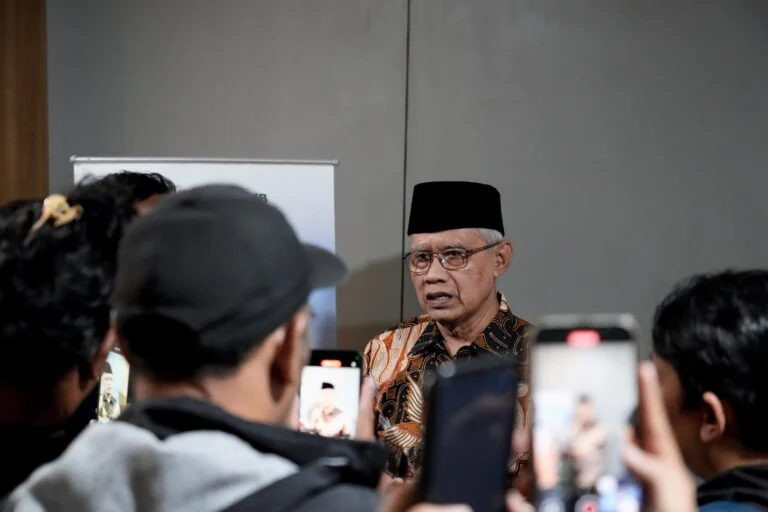
EN.MUHAMMADIYAH.OR.ID, YOGYAKARTA – Haedar Nashir, President of Muhammadiyah, has warned that corruption in Indonesia has reached an alarming level. He described it as systemic, widespread, and deeply entrenched within the nation’s institutions.
He made the remarks before delivering a lecture at the Leadership Training Program for Muhammadiyah and ‘Aisyiyah University, held at Prime UMY Hotel Convention & Dormitory on Monday (13/7).
According to Haedar, the repeated exposure of corruption cases—including the arrests of several regional leaders by the Corruption Eradication Commission (KPK) in recent months—shows that corruption is no longer merely a matter of individual misconduct but has evolved into a structural problem.
“Like an epidemic, corruption has spread into an acute disease that is systemic, structured, and massive,” Haedar said.
He linked the issue to the seventh pillar of President Prabowo Subianto’s Asta Cita agenda, which calls for strengthening political, legal, and bureaucratic reform while intensifying efforts to combat corruption and narcotics. In his view, the President’s public speeches demonstrate a clear commitment to tackling corruption.
“Corruption has become one of Indonesia’s most fundamental burdens, alongside challenges such as meeting basic needs, creating jobs, and reducing poverty,” he said. “Therefore, I believe we all share the responsibility to fight corruption together.”
Three Priorities for Reform
Drawing on Muhammadiyah’s longstanding commitment to good governance, Haedar outlined three strategic priorities for addressing corruption.
First, he argued that President Prabowo should personally lead the national anti-corruption campaign through the institutions that already exist.
“Because this is now a national emergency, the President, as head of the executive branch, must directly lead the fight against corruption through the institutions that have already been established,” he said. “The problem has become structured, massive, and systemic.”
Haedar emphasized that presidential leadership is essential to building a clean system of governance. Strong and consistent law enforcement, he said, would safeguard the nation’s sovereignty and support Indonesia’s long-term development goals.
He added that a serious commitment to strengthening anti-corruption institutions could become one of the defining legacies of the current administration.
“I believe the President will be remembered as a national leader who left a lasting legacy by successfully combating corruption through the country’s institutions,” he said.
Second, Haedar called for closer coordination among all law enforcement agencies, including the National Police, the Attorney General’s Office, the Corruption Eradication Commission (KPK), the Supreme Audit Agency (BPK), and other oversight bodies.
According to him, corruption can only be addressed effectively through an integrated institutional framework.
A Shared National Commitment
“Only through a strong system can we eradicate corruption and resolve other national challenges,” he said. “Moral appeals alone are not enough. Even religion has its limits when confronting problems that have become embedded within the system.”
Haedar argued that the success of major government initiatives depends on clean governance and credible law enforcement.
He therefore urged the President to lead with firm political commitment while working closely with policymakers and state institutions.
“In that context, I believe there should be no obstacles between institutions because this concerns the interests of the nation,” he said.
Acknowledging that every institution has its shortcomings, Haedar stressed that such limitations should never weaken anti-corruption efforts.
“Despite our respective weaknesses, we must continue to maximize every opportunity through sound public policy,” he said. “What matters is that we remain united and demonstrate strong political will.”
He further argued that fighting corruption must become the state of mind of the entire nation, extending beyond government institutions to civil society organizations.
“We must build a collective mindset so that no public space or institutional ecosystem leaves room for corruption,” he said.
As his third point, Haedar noted that no institution is flawless. Nevertheless, he said, sustained political determination to improve governance remains the key to meaningful reform.
“There is no broom that is perfectly clean,” he remarked. “What matters is an optimal political will from all of us to continue taking concrete steps against corruption.”
Concluding his remarks, Haedar called on all sectors of society, including the media, to continue supporting the country’s anti-corruption agenda.
“We must continue raising our voices and never grow weary,” he said. “Eradicating corruption and solving our national challenges is a long-term mission. There must be no slowdown, only greater acceleration.” (bhisma)
The post Haedar Nashir Urges Three Strategic Measures to Fight Indonesia’s Systemic Corruption appeared first on Muhammadiyah Official Website - English Version.








No comments yet. Be the first to share your thoughts!